SignFormer-GCN: Continuous Sign Language Translation Using Spatio-Temporal Graph Convolutional Networks
1Dept. of Robotics and Mechatronics Engineering, University of Dhaka 2Dept. of Electrical and Computer Engineering, North South University
PLOS ONE 20(2): e0316298, 2025 · Accepted at the WiML Workshop, NeurIPS 2025
TL;DR
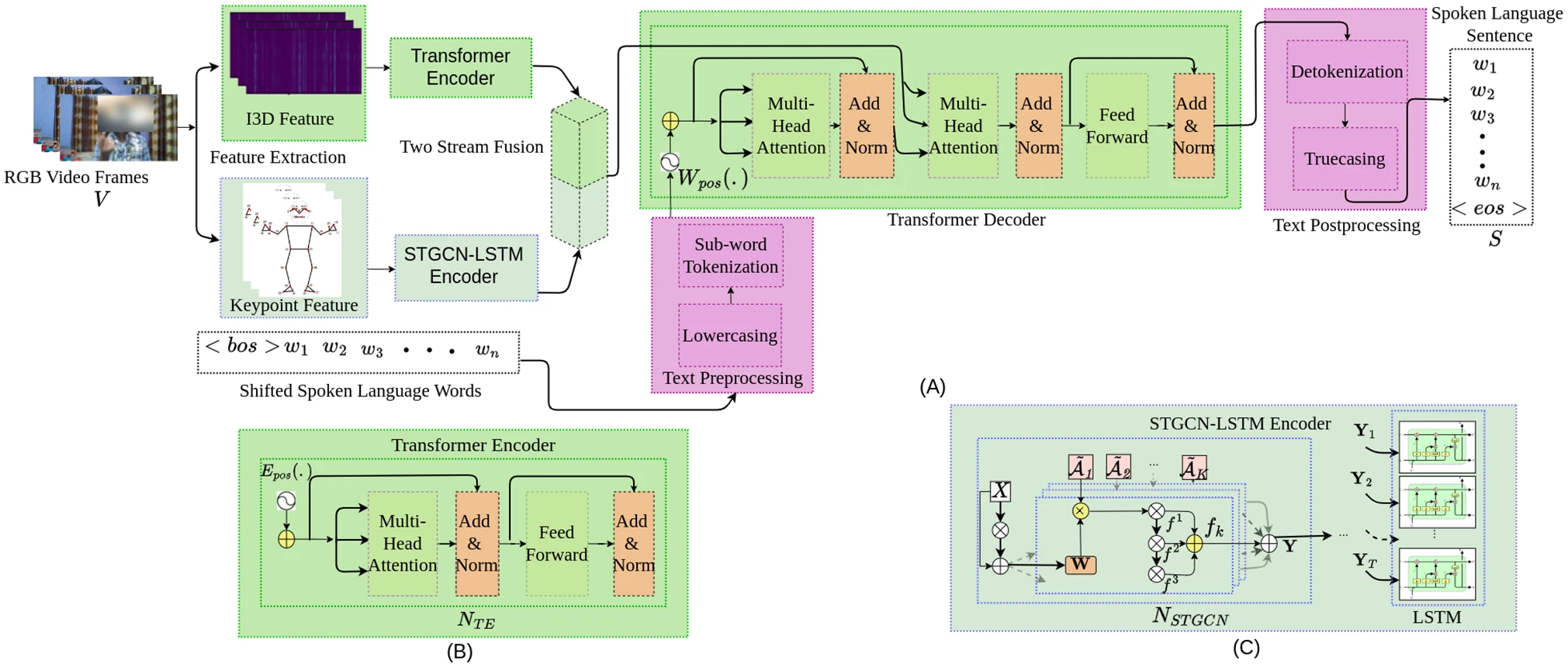
Transformers over RGB capture context but miss the skeleton's graph structure. SignFormer-GCN adds a spatio-temporal graph stream over keypoints, so the model sees both what the scene looks like and how the body moves.
- 19.75BLEU-4 on RWTH-PHOENIX-2014T (gloss-free)
- 8.53BLEU-4 on How2Sign test, best among compared methods
- 9.43Mparameters, vs. 115.41M for GFSLT-VLP
Abstract
Sign language is a complex visual language system that uses hand gestures, facial expressions, and body movements to convey meaning. It is the primary means of communication for millions of deaf and hard-of-hearing individuals worldwide. Tracking physical actions, such as hand movements and arm orientation, alongside expressive actions, including facial expressions, mouth movements, eye movements, eyebrow gestures, head movements, and body postures, using only RGB features can be limiting due to discrepancies in backgrounds and signers across different datasets. Despite this limitation, most Sign Language Translation (SLT) research relies solely on RGB features. We used keypoint features, and RGB features to capture better the pose and configuration of body parts involved in sign language actions and complement the RGB features. Similarly, most works on SLT research have used transformers, which are good at capturing broader, high-level context and focusing on the most relevant video frames. Still, the inherent graph structure associated with sign language is neglected and fails to capture low-level details. To solve this, we used a joint encoding technique using a transformer and STGCN architecture to capture the context of sign language expressions and spatial and temporal dependencies on skeleton graphs. Our method, SignFormer-GCN, achieves competitive performance in RWTH-PHOENIX-2014T, How2Sign, and BornilDB v1.0 datasets experimentally, showcasing its effectiveness in enhancing translation accuracy through different sign languages.
Results
RWTH-PHOENIX-2014T · gloss-free · higher is better
| Method | BLEU-1 | BLEU-2 | BLEU-3 | BLEU-4 |
|---|---|---|---|---|
| Conv2d-RNN | 27.10 | 15.61 | 10.82 | 8.35 |
| Joint-SLT | 30.88 | 18.57 | 13.12 | 10.19 |
| Tokenization-SLT | 37.22 | 23.88 | 17.08 | 13.25 |
| TSPNet-Joint | 36.10 | 23.12 | 16.88 | 13.41 |
| GASLT | 39.07 | 26.74 | 21.86 | 15.74 |
| GFSLT-VLP (115.41M params) | 43.71 | 33.18 | 26.11 | 21.44 |
| SignFormer-GCN (9.43M params) | 41.19 | 30.89 | 24.23 | 19.75 |
SignFormer-GCN is competitive with the much larger GFSLT-VLP at roughly one-twelfth of the parameters.
How2Sign (American Sign Language)
| Method | Val rBLEU | Val BLEU-4 | Test rBLEU | Test BLEU-4 |
|---|---|---|---|---|
| slt_how2sign | 2.79 | 8.89 | 2.21 | 8.03 |
| asl_video2text | 3.29 | 9.39 | 2.56 | 7.95 |
| SignFormer-GCN | 3.97 | 9.90 | 2.96 | 8.53 |
What matters
- The graph stream helps: adding the STGCN-LSTM encoder improves test BLEU-4 on PHOENIX-2014T from 18.80 to 19.75.
- Simple fusion works best: fusing the two streams by summation outperformed a linear-layer or LSTM fusion.
Citation
@article{arib2025signformer,
  title   = {{SignFormer-GCN}: Continuous Sign Language Translation Using
             Spatio-Temporal Graph Convolutional Networks},
  author  = {Arib, Safaeid Hossain and Akter, Rabeya and Rahman, Sejuti and Rahman, Shafin},
  journal = {PLOS ONE},
  volume  = {20},
  number  = {2},
  pages   = {e0316298},
  year    = {2025},
  doi     = {10.1371/journal.pone.0316298}
}