Counting Through Occlusion: Framework for Open World Amodal Counting
1Department of Robotics and Mechatronics Engineering, University of Dhaka
arXiv preprint arXiv:2511.12702 · Submitted to WACV 2027
TL;DR
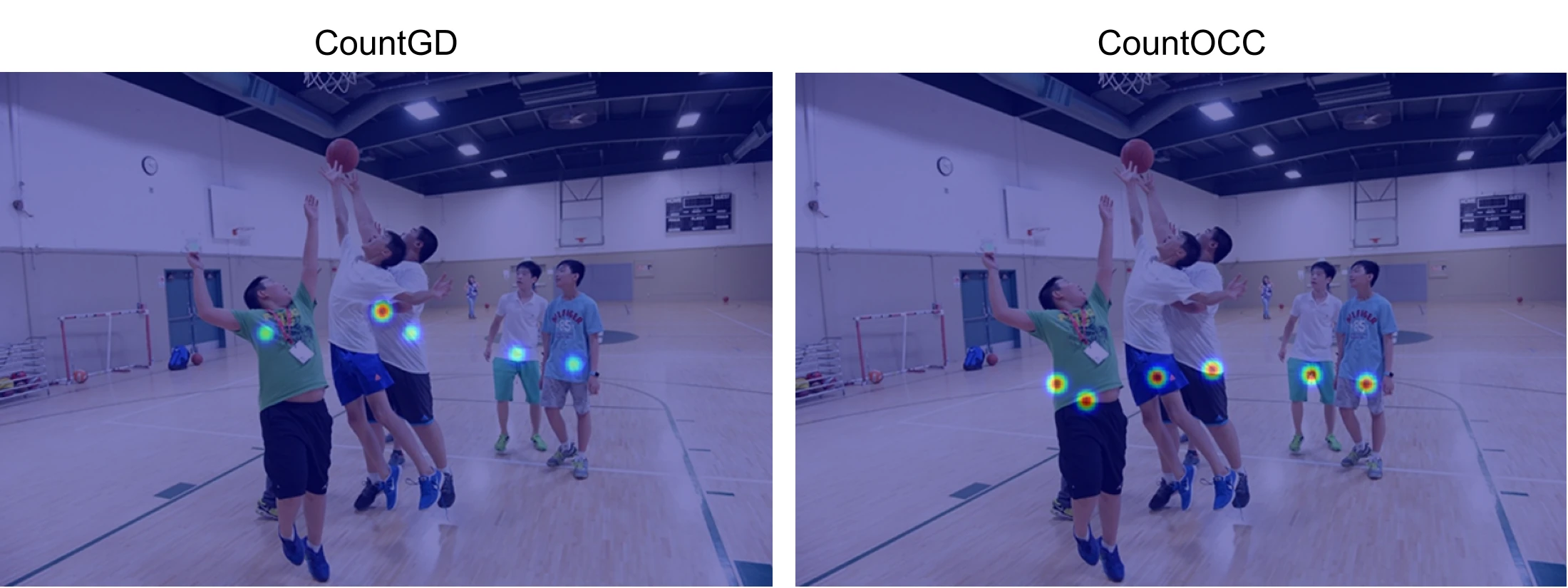
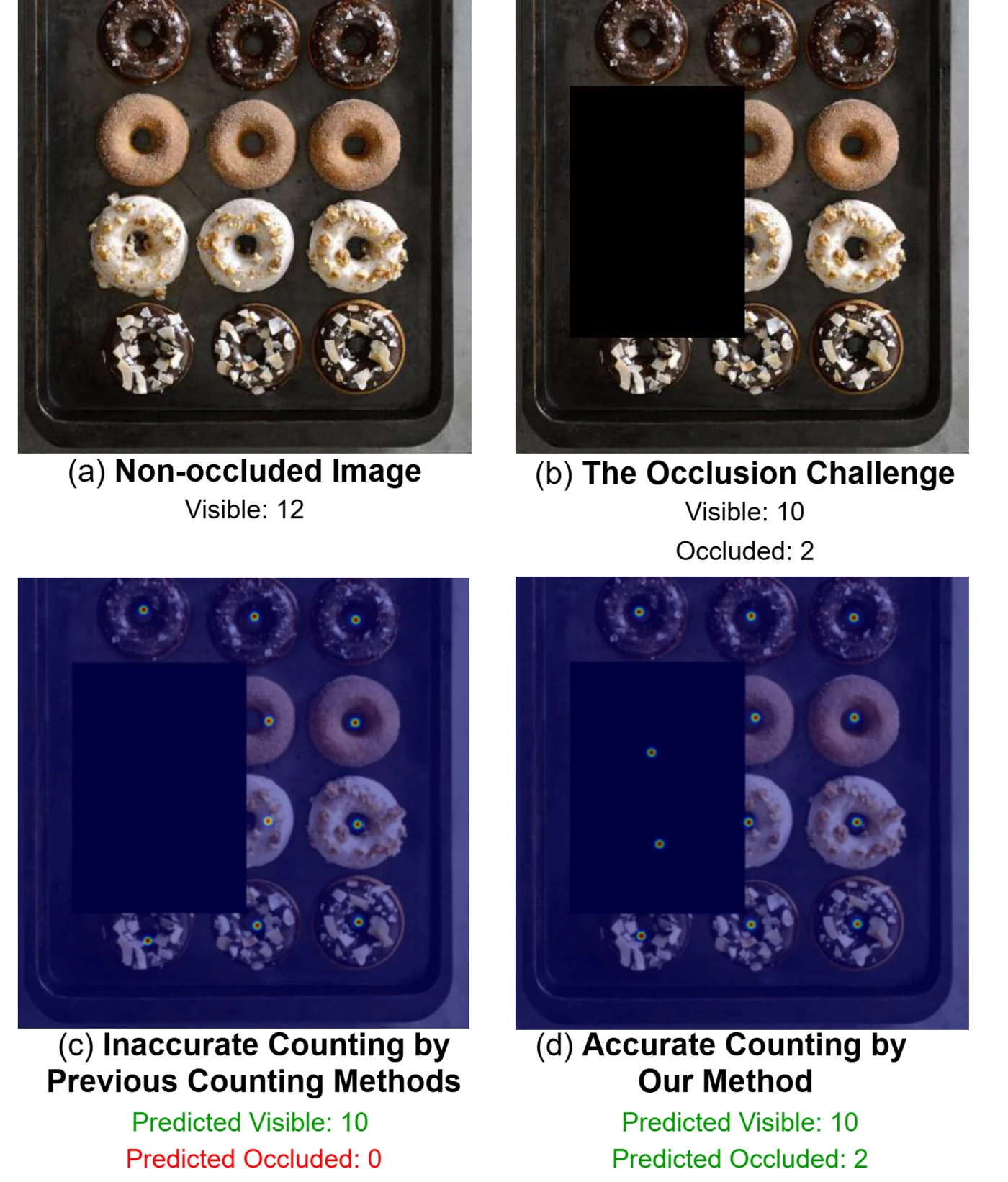
Under occlusion, a backbone encodes the occluder, not the objects behind it. CountOCC rebuilds features at occluded locations from visible fragments plus text and exemplar priors, and trains the occluded view to attend like the clean view.
- −20.8%test MAE on FSC-147-OCC vs. CountGD (−26.7% on validation)
- −49.9%MAE on CARPK-OCC (9.28 → 4.65)
- −28.8%MAE on CAPTURe-Real (14.97 → 10.66)
Abstract
Object counting has achieved remarkable success on visible instances, yet state-of-the-art (SOTA) methods fail under occlusion. This failure stems from a fundamental architectural limitation where backbone networks encode occluding surfaces rather than target objects, thereby corrupting the feature representations required for accurate enumeration. To address this, we present CountOCC, an amodal counting framework that explicitly reconstructs occluded object features through hierarchical multimodal guidance. Rather than accepting degraded encodings, we synthesize complete representations by integrating spatial context from visible fragments with semantic priors from text and visual embeddings, generating features at occluded locations across multiple pyramid levels. We further introduce a visual equivalence objective that enforces consistency in attention space, ensuring that both occluded and unoccluded views of the same scene produce spatially aligned gradient-based attention maps. Together, these complementary mechanisms preserve discriminative properties essential for accurate counting under occlusion. For rigorous evaluation, we establish occlusion-augmented versions of FSC-147 and CARPK (FSC-147-OCC and CARPK-OCC). CountOCC achieves SOTA performance on FSC-147-OCC with 26.72% and 20.80% MAE reduction over prior baselines under occlusion in validation and test, respectively. CountOCC also demonstrates exceptional generalization by setting new SOTA results on CARPK-OCC with 49.89% MAE reduction and on CAPTURe-Real with 28.79% MAE reduction, validating robust amodal counting.
The occlusion problem
Motivation
Method
Reconstruct, then align
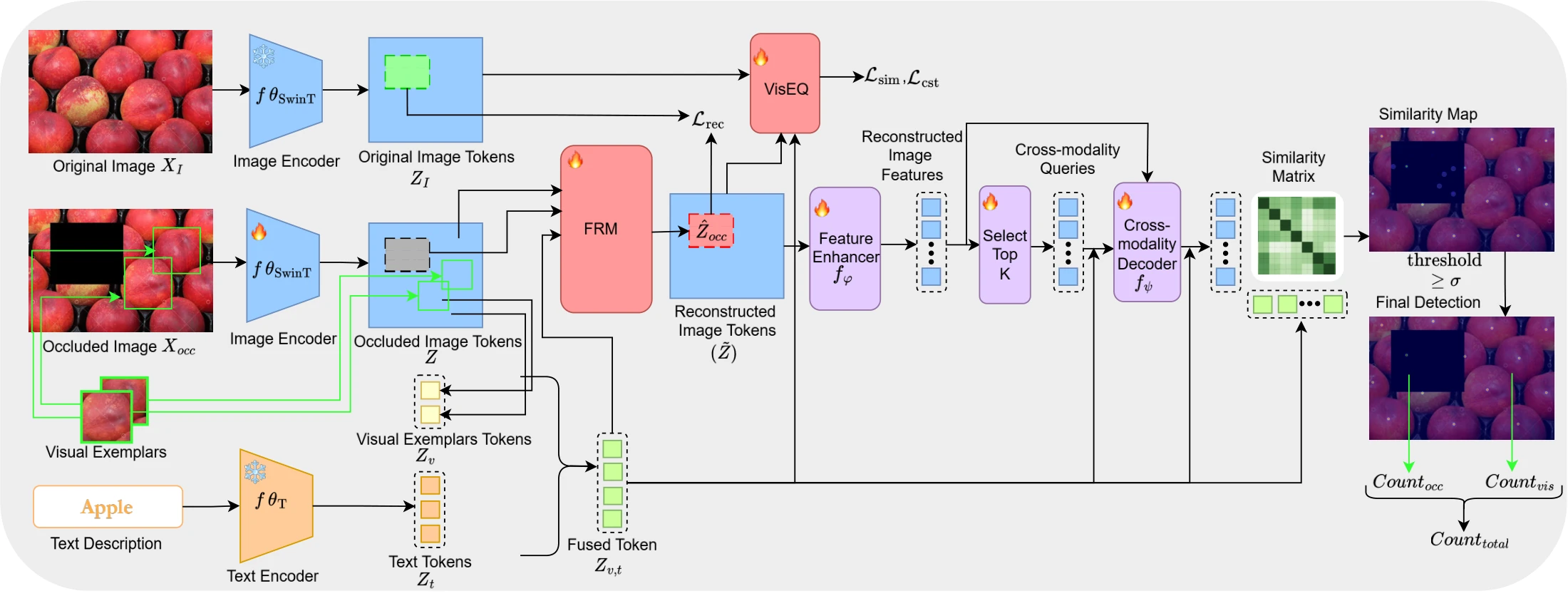
- Feature Reconstruction ModuleLearnable queries at occluded positions self-attend, cross-attend to visible tokens for spatial context, then cross-attend to fused text–exemplar embeddings for semantics, producing class-discriminative features where the occluder was.
- Visual Equivalence (VisEQ)A teacher sees the clean image, a student sees the occluded one. Attention-similarity and ROI-consistency losses make their gradient-based attention maps agree, so localization does not depend on occlusion.
- New benchmarksFSC-147-OCC and CARPK-OCC add controlled occlusion to standard open-world and car-counting datasets for rigorous amodal evaluation.
Results
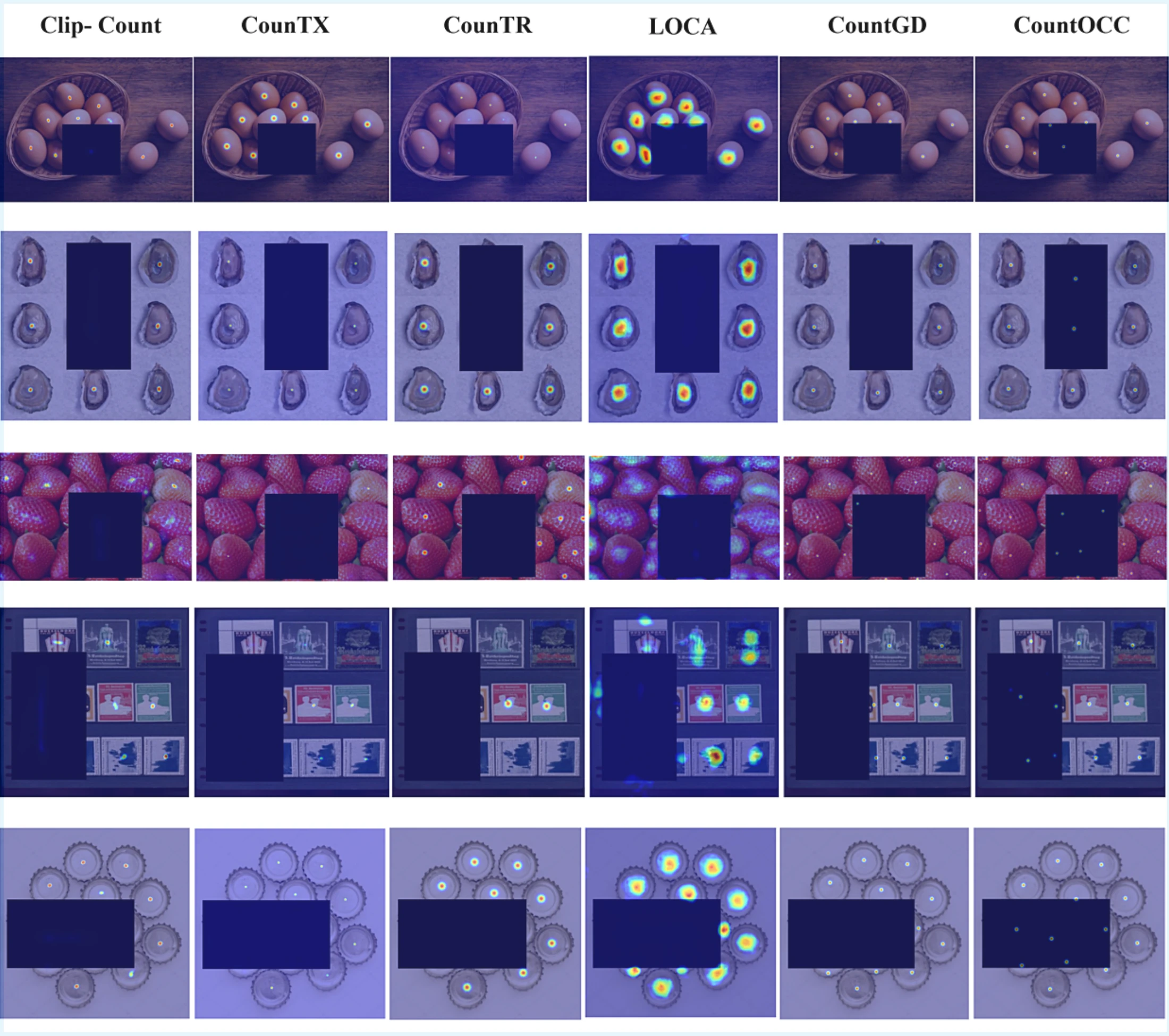
FSC-147-OCC · MAE / RMSE · lower is better
| Method | Prompt | Val MAE | Val RMSE | Test MAE | Test RMSE |
|---|---|---|---|---|---|
| CLIP-Count | Text | 26.31 | 80.45 | 23.90 | 108.57 |
| CounTX | Text | 24.81 | 75.58 | 23.04 | 113.83 |
| CounTR | Exemplars | 23.14 | 66.78 | 22.25 | 104.75 |
| LOCA | Exemplars | 17.13 | 44.25 | 16.77 | 78.41 |
| CountGD | Exemplars + Text | 15.83 | 54.38 | 14.42 | 85.40 |
| CountOCC | Exemplars + Text | 11.60 | 35.40 | 11.42 | 38.68 |
Generalization
| Benchmark | CountGD MAE | CountOCC MAE | Reduction |
|---|---|---|---|
| CARPK-OCC (test) | 9.28 | 4.65 | −49.9% |
| CAPTURe-Real | 14.97 | 10.66 | −28.8% |
Citation
@article{arib2025countocc,
  title   = {Counting Through Occlusion: Framework for Open World Amodal Counting},
  author  = {Arib, Safaeid Hossain and Akter, Rabeya and Chowdhury, Abdul Monaf and
             Sourov, Md Jubair Ahmed and Hasan, Md Mehedi},
  journal = {arXiv preprint arXiv:2511.12702},
  year    = {2025}
}