Classical Machine Learning Approach for Human Activity Recognition Using Location Data
UbiComp/ISWC '21 Adjunct: Adjunct Proceedings of the 2021 ACM International Joint Conference on Pervasive and Ubiquitous Computing and the 2021 ACM International Symposium on Wearable Computers
TL;DR
Can a phone tell whether you are walking, cycling, or on a train from location data alone? A carefully engineered classical pipeline gets close to 80%.
- 78.14%validation accuracy
- 78.28%weighted F1 score
- 8locomotion and transportation modes
Overview
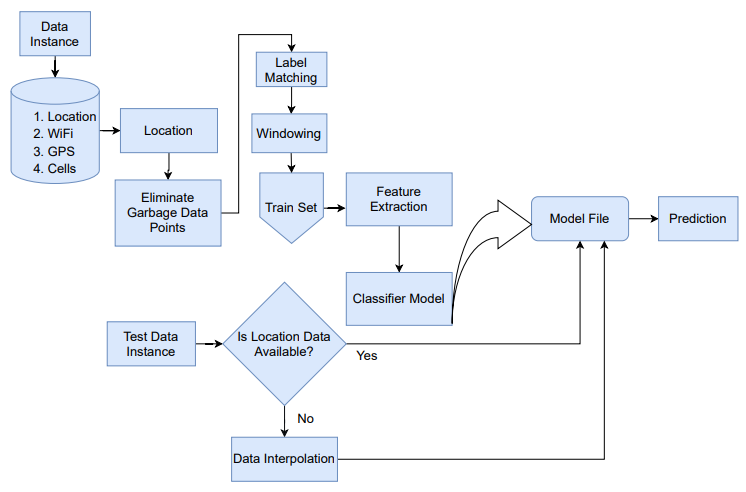
The Sussex-Huawei Locomotion (SHL) Challenge 2021 asks participants to recognize eight modes of locomotion and transportation from smartphone sensor data. Our team worked with the location modality (location, GPS, WiFi, and cellular signals) and asked how far a carefully engineered classical pipeline could go.
We removed noisy data points, matched labels to location samples, segmented the stream into windows, and extracted statistical features for a random forest classifier. When location data was unavailable at test time, we interpolated the gaps before prediction. The approach reached 78.14% validation accuracy and a 78.28% weighted F1 score, placing 11th in the challenge.
Citation
@inproceedings{arib2021classical,
  title     = {Classical Machine Learning Approach for Human Activity Recognition Using Location Data},
  author    = {Arib, Safaeid Hossain and Akter, Rabeya and Shahid, Omar and Ahad, Md Atiqur Rahman},
  booktitle = {Adjunct Proceedings of the 2021 ACM International Joint Conference on Pervasive and
               Ubiquitous Computing and Proceedings of the 2021 ACM International Symposium on
               Wearable Computers},
  year      = {2021},
  doi       = {10.1145/3460418.3479376}
}